Friday, May 30, 2008

Die Cast parts stronger than steel


Kinetic Die Casting published this remark "Aluminum Die Casting Parts
Stronger Than Steel"
over two years ago. Recently a Google Alert showed the exact content on another web site stating another companies name. The content was copied exactly, only the company name was changed to get traffic to another web site representing a die casting company. Kinetic Die Casting also has this information listed on our die casting answers page Our customers are usually Original Equiptment Manufacturers (OEMs), these OEM manufacturers may need over 1,000,000 of these aluminum diecast parts a year or as few as 100 aluminum diecasting parts a year. Some of our aluminum diecasting parts have a production rate of 100 parts a day and others can be produced at the rate of 1,000's of diecasting parts a day.

Saturday, May 10, 2008

NTMA National Tooling and Machining Association

The NTMA is the national representative of the custom precision manufacturing industry in the United States.

Many NTMA members are small businesses, privately owned and operated, yet the industry generates sales in excess of $40 billion a year. Our nearly 2000 members design and manufacture special tools, dies, jigs, fixtures, gages, special machines, and precision machined parts. Some firms specialize in experimental research and development work.

The tooling and machining industry is critical to our country's economic health as it makes possible the existence of virtually every other manufacturing industry. Tooling is, in its simplest sense, the means of production. "Special" tooling, such as dies and molds, is custom designed and made to manufacture specific products, generally in quantity, and to desired levels of uniformity, accuracy, interchangeability, and quality. Machining involves the use of a wide variety of machine tools to cut or form material, usually metal, to precise shapes and dimensions.

NTMA member companies use the full range of machine tools and related equipment, ranging from small automatic lathes for miniature parts, to enormous boring mills. The industry is probably the most technologically-advanced of all small manufacturing activities, and enjoys widespread deployment of computer-numerically-controlled (CNC) machines and other computer-aided design and manufacturing (CAD/CAM) techniques.

Our industry supplies the necessary precision tooling and machining for such vital industries as defense, automotive, aerospace, appliance, business machines, electronics, agricultural implements, ordnance, transportation, environmental, construction equipment, nuclear, and many more. In point of fact, nearly every manufacturer does business at one time or another with the contract tooling and machining industry.
NTMA San Fernando Valley

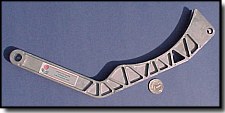
Tuesday, May 6, 2008

Die Casting History

Die Casting has been around a long time. The earliest examples of die casting by pressure injection - as opposed to casting by gravity pressure - occurred in the mid-1800s. A patent was awarded to Sturges in 1849 for the first manually operated machine for casting printing type. The process was limited to printer’s type for the next 20 years, but development of other shapes began to increase toward the end of the century. By 1892, commercial applications included parts for phonographs and cash registers, and mass production of many types of parts began in the early 1900s.

Die casting has evolved from the original low-pressure injection method to techniques including high-pressure casting. These modern processes are capable of producing high integrity, near net-shape castings with excellent surface finishes. Information from NADCA and Kinetic Die Casting

Saturday, May 3, 2008

www.manufacturing.gov

This website, www.Manufacturing.gov shows the ideas and innovation that the U.S. Government is working to develop for the future of the American worker. The website It also brings together information on key issues for manufacturers and service industries, such as regulatory reform and economic growth policies, as well as resources available from the Government that help to improve the business climate for U.S. manufacturing.

You will also find information on the Manufacturing Council, the Interagency Working Group on Manufacturing for Competitiveness, the National Science and Technology Council"s (NSTC) Interagency Working Group on Manufacturing R&D, and the President’s Export Council and their recommendations to strengthen the international economic position of the United States and to develop a public policy environment that advances U.S. competitiveness at home and abroad.
Aluminum Parts Die Casting Company
