Aluminum Parts and supporting businesses for manufacturing. Manufacturing blog for Kinetic Die Casting for post regarding manufacturing aluminum parts and for other products that support the manufacturing industry. Some production parts are made by other materials and some posts will be for supporting businesses.
Showing posts with label die cast tooling. Show all posts
Showing posts with label die cast tooling. Show all posts
Tuesday, March 22, 2016
Die Cast Tooling Info


Tuesday, October 13, 2015
Molds that Fit
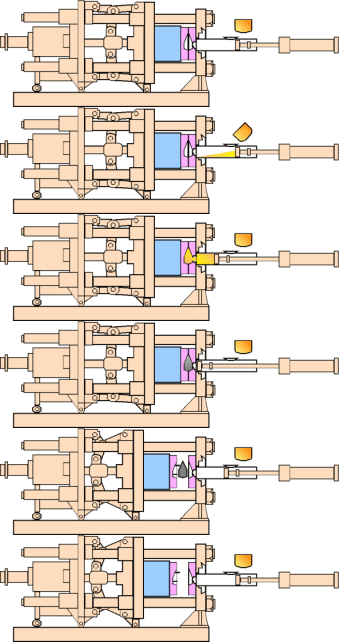
In the die casting industry, there are two machines used, namely the hot chambered die cast machine and the cold chambered die cast machine. Each machine has its own distinct advantages and disadvantages such as the hot chambered die cast machine can finish the product in less time than the cold chambered die cast machine; however there are non ferrous metals that cannot be die casted using the former. Whichever machine a company is using, it is essential that they give some time and thought into the Die Casting Tooling as these are the most crucial tools of the whole process.
Furthermore, die cast molds or Die Casting Tooling can be very expensive. They are made from hardened steel and they come in different shapes and sizes. Their cost can vary from a couple hundred dollars to several thousand dollars, depending on the size and complexity of the mold. There are single cavity molds and several cavity molds to cater to whatever the manufacturer needs to accomplish.
Kinetic Die Casting manufactures products like heatsink die casting, aluminum housings, and lighting fixtures. If you would like more information, please visit our website:Kinetic Die Casting Company
Thursday, August 12, 2010
The Advantages of Aluminum Chassis Castings Over Steel
The Advantages of Aluminum Chassis Castings Over Steel. High pressure die casting is the process used to make aluminum die cast parts and chassis castings. This process is now becoming more and more popular in several major manufacturing industries because of its many advantages.
three times greater axial load strength
Faster production rate. In fact, production quantities can be done within a few days instead of several weeks!
Fewer failures and returns to the OEM
Weight is lighter by two and a half times for lesser shipping costs
Less finishing costs
Raw parts manufacturing costs are much less
Better looking parts
You can produce aluminum die casts according to your preference and specifications, such as the trim, clean, machine, inspect, powder coat and the package of your aluminum cast parts.
All in all, the use of aluminum castings over still helps you reduce weight, boost strength, and save you more money.

To get a price for aluminum die casting parts or die casting tooling, call toll free 800-524-8083 and ask for sales. Or email us at sales@kineticdc.com for a fast response on a price quote.
Aluminum is a great metal to work with. Unlike other metals, it has plenty of strengths. The metal can be found almost everywhere in the planet. Supply will not run out, so it is easy to acquire and not heavy on your pockets.
Advantages of aluminum chassis castings over steel include:
You can produce aluminum die casts according to your preference and specifications, such as the trim, clean, machine, inspect, powder coat and the package of your aluminum cast parts.
All in all, the use of aluminum castings over still helps you reduce weight, boost strength, and save you more money.
To get a price for aluminum die casting parts or die casting tooling, call toll free 800-524-8083 and ask for sales. Or email us at sales@kineticdc.com for a fast response on a price quote.
Thursday, May 13, 2010
Why Should You Use Aluminum Military Parts?
Why Should You Use Aluminum Military Parts? Many of the government’s military equipment and weapons are manufactured and made with aluminum parts or die casting parts. There are many advantages when using aluminum to create military parts, and in this article, the most common advantages will be enumerated and explained.
When forging the military parts using aluminum, the manufacturers are able to produce more complex parts with thinner walls and sections, low finishing costs, and have coring that is normally not feasible in forging. This means that one is able to produce parts that are more difficult than their predecessors but are more tolerable, durable, and of course less costly.
Aluminum is a more durable, stronger, and more dimensionally stable alloy to use than when using plastic moldings to create military parts. This is because aluminum parts are able to prevent radio frequency, electromagnetic emissions, and other possible effects that could damage the parts. So if you want your military equipment to remain stable and strong despite constant use, this is the kind of alloy and the kind of molding to be used.
Normally extrusions are used to produce the parts and to give it shape, but with aluminum die casting, the parts are produced faster in terms of speed and with more net shape than usual.
To get a price for aluminum die casting parts or die casting tooling, call toll free 800-524-8083 and ask for sales. Or email us at sales@kineticdc.com for a fast response on a price quote.
To get a price for aluminum die casting parts or die casting tooling, call toll free 800-524-8083 and ask for sales. Or email us at sales@kineticdc.com for a fast response on a price quote.
Thursday, April 29, 2010
Pressure Die Casting Aluminum Speaker Parts vs Extrusions
Pressure Die Casting Aluminum Speaker Parts vs Extrusions. Speakers and other sound-related components don’t live without going through maintenance and parts replacement. Eventually, after months or years of use, parts need to be replaced with newer ones to continue its lifespan. Many of today’s consumers would turn to die casting to be able to get parts instead of buying a new component every time a part of the system starts malfunctioning, and one of the processes used to create speaker parts is extrusions. Extrusion, if you look it up over the net, is basically a process used to create objects (in this case, parts) of a fixed cross-sectional body. The top advantages of using extrusions are being able to create complex cross-sections and being able to work with materials that are normally brittle and that can easily break.
To get a price for aluminum die casting parts or die casting tooling, call toll free 800-524-8083 and ask for sales. Or email us at sales@kineticdc.com for a fast response on a price quote.
But because of the limitations involved in extrusions when it comes to shaping and the time spent to produce the parts, manufacturers are now turning to pressure die casting using aluminum as the main alloy. As compared to extrusions, die casting with aluminum makes production faster, allows more net shape, and all the features of the part, from top to bottom, side to side, can be done in one operation alone.
To get a price for aluminum die casting parts or die casting tooling, call toll free 800-524-8083 and ask for sales. Or email us at sales@kineticdc.com for a fast response on a price quote.
Thursday, January 21, 2010
Die Casting Tooling 101: Cavities, Mold Halves And Clamping Pressure
Die Casting Tooling 101: Cavities, Mold Halves And Clamping Pressure. Die casting tooling may seem innocuous, but this is an integral part of any die casting production. Die casting tooling may also be referred to as die casting molds or die casting dies. In many instances, these are referred to simply as dies or molds. As such, there are 4 types of cavities, depending upon the pieces that are to be made and the sophistication of the machines carrying out the production. These cavities range from the singe cavity die (single, solid component); the multiple cavity die (several similar pieces can be made at the same time using on die); unit dies (dissimilar pieces are processed that usually fit into one workable component); and the combination die or combo die (where the die works with most or all of the other aforementioned functions.) Most assembly line production these days utilizes combo dies.
Die Cast Tooling Dies have two halves: the cover half which remains constant all throughout the processing stage; and the ejector half. The ejector half is not only detachable, but this also contains the spruce holes, the inlets and the runners that are necessary in the construction of very sophisticated pieces.
During processing, the machine usually locks the dies by automatic hydraulic pressure. This clamping pressure is governed by two factors namely: the pressure required for the machine to “force” the molten material within the die cavity and the total projected surface area of the pieces that are supposed to be cast. The former depends on the actual machine being used in the production (hot chamber or cold chamber). The latter depends on the measurement of the die parting line or the part where the two halves of the die actually meets.
Monday, December 21, 2009
Die Casting Alloy and Materials
Main die casting alloy and materials used in conjunction with die casting molds
Materials that are used for casting and used in conjunction of die cast molds come in many forms. And the choice of which materials to use will depend on the manufacturer and will depend on the characteristics of the material alloys. Each of the following materials and alloys has its own properties and benefits, and manufacturers often choose from among these materials and weigh the pros and cons of the alloys and materials.
Materials that are used for casting and used in conjunction of die cast molds come in many forms. And the choice of which materials to use will depend on the manufacturer and will depend on the characteristics of the material alloys. Each of the following materials and alloys has its own properties and benefits, and manufacturers often choose from among these materials and weigh the pros and cons of the alloys and materials.
The main materials or alloys used include zinc, aluminum, and magnesium, copper, lead and tin. The alloys and have its own set of advantages and benefits when used and it is imperative that industrial manufacturers should know what makes one alloy or material superior to the next one. In terms of the material that is easiest to cast then that material is zinc. This material is known for their high ductility, for high impact strength and will be known for its economy. The aluminum material is known for its light weight and known as the material that with high dimensional stability when used for complex shapes and thin walls. The material is known to be reliable against corrosion and has good mechanical properties.
The magnesium is the alloy that is easiest to machine and known for its excellent strength to weight ratio. Copper is another material used in conjunction with the die casting molds and the alloy form copper is known for high hardness and a better material that can withstand corrosion. Lead and thin are two other alloy materials used when casting.
Saturday, November 21, 2009
Die Casting Tools Machines Used In Production
Die Casting Tools Machines Used In Production. Casting metals has certainly evolved from its earliest metallurgy practices. Formerly, the creation of alloy pieces from molten materials (like tin, steel, brass, silver and gold) was performed by hand. These days, thanks to advancements in technology, and a formal introduction of the die casting process by Elisha Root in 1830, pieces made from these practices can be made more economical, faster, safer, and yes, on a larger scale. The one difference is that precious metals like brass, silver and gold can hardly be used now in mass production, although die casting for jewelries is still practiced, albeit not prevalent.
Among the most prominent of all advancements in the die casting tools category are the actual machines used for mass productions. These machines are the cold chamber machines and the hot chamber machines.
The type of machines being used in die casting usually depends on the actual alloys of metals that are to be used during production. Because these machines are rather expensive and bulky at best, (and so are the raw materials needed to do the work) there are more companies now who either use cold machines exclusively or hot machines exclusively.
Cold chamber machines are suited for alloys that have a higher melting point. This would include aluminum and other alloys that may have higher aluminum content. On the other hand, alloys or pure metals that have low melting points can be processed in hot chamber machines. Such metals include: copper, lead, magnesium or zinc. Alloys that have higher concentrations of these aforementioned metals usually have lower melting points, regardless of the other metals introduced in the mix, and are therefore more suited for the hot chamber machines.
Monday, September 21, 2009
The many forms of die cast tooling
The many forms of die cast tooling
Die cast tooling that is used in the industry to produce different parts, accessories and products come in many forms. And the tooling also comes in many names in the industry and for other industry players the tooling is called as the insert die, the die casting dies or known as the die casting molds.
Die cast tooling that is used in the industry to produce different parts, accessories and products come in many forms. And the tooling also comes in many names in the industry and for other industry players the tooling is called as the insert die, the die casting dies or known as the die casting molds.
The cast tooling may come in many sizes styles and values and used in different applications and industries. The tooling may come in the single cavities or in multiple cavities. The single cavities are known for their one part cycle and the multiple cavities are known for more than one part for each cycle. Prices of these many forms of die cast tooling may vary as well. Some of the cast tooling may come in the market for a few hundred dollars and some for a few thousand dollars.
The many forms of die cast tooling includes the inserts, the prototype die cast tooling inserts, the unit die tooling, the Class A die cast die, the die cast family mold tooling and the die casting trim dies for the die cast parts. Of these many forms of cast tooling, the die cast tooling insert is considered as the least expensive. The inserts may require proper heating in order to extend its lifespan. Once the inserts are too hard for comfort then these inserts will be compromised due to the high temperature of the molten metal and it may also crack the steel. If the insert is too soft then of course the insert may get damaged easily.
Friday, August 21, 2009
Inserts For Die Casting Tooling
Inserts For Die Casting Tooling. There are four types of die cast tools. These are: the single cavity die, the multiple cavity die, the unit die and the combination die. However, all of these dies may have one thing in common. These may be using smaller pieces of metals called inserts. With the advancement in the designing process, many of the more sophisticated die casting tooling can now be fabricated successfully using these smaller pieces of metal. Although these may look nothing more than thin rods of material or even a blob of metal (literally) inserted in the die, inserts are probably the best and most economical way of creating sophisticated cast die pieces.
The main purpose of inserts is to create the holes or the running tubes within the piece. In earlier times, these holes or tubes can only be “placed” within a finished piece by manually or mechanically gouging it out. Needless to say, this can be a pricey affair especially if you consider the actual cost of hiring either skilled workmen to drill the holes or buying machines for the same purpose. Also this practice was subject to a lot of errors and therefore not feasible for mass production – especially when quality control is very rigid.
Fortunately, inserts can now be easily accommodated in most cast die machines. The material used for inserts depend on the actual materials being processed by the machines. As a rule hot chamber machines use molten materials with lower melting points like copper, lead, magnesium and even zinc. On the other hand, cold chamber machines use mainly aluminum or aluminum based alloys which have higher melting points. The inserts are made from the same materials as the actual die, usually steel alloys, but these are reinforced to make sure that metal erosion does not take place during the actual production stage.
Tuesday, July 21, 2009
Tooling Answers: What is Die Casting
Tooling Answers: What is Die Casting? Die casting is a process where reusable steel molds are produced by facing molten metal under high pressure into mold cavities. The produced molds are called dies.
The process of die casting has four big steps. The process begins by spraying the mold with lubricant. Then the mold is closed. The lubricant not only serves to control the dies’ temperature but also helps in the removal of the casting. Molten metals under high pressure are forced into the die. After filling the die, high pressure must continue until casting solidifies. Then the die is opened and the shot is forced out by the ejector pins. Finally, the scraps are separated from the castings. Grinding is done to smooth the scrap marks. The scraps are re-melted for recycling.
Aluminum Parts made from Die casting molds can be designed to produce shapes with accuracy and repeatability. The parts are sharply defined. Surfaces are either smooth or textured.
The die casts parts are components of many products like automobiles, sink faucet, toys, connector housings and many more. Die cast tooling, sometimes called insert die or zinc die casting molds, have many styles, sizes and values. Die cast tooling comes in several forms. The Die Cast Tooling Inserts, the Prototype Die Cast Tooling Inserts, the Trim Dies for Die Cast Tools and Parts, the Complete Class “A” Die Cast Die or Mold Tooling, the Unit Die Tooling and Die Cast Family Mold Tooling.
Costs of die cast tooling vary from a few hundred dollars for trim dies, a few thousand dollars for cavity inserts and more thousand dollars for large complete die cast tools package.
Saturday, July 4, 2009
Manufacturing Diecasting Tooling
Manufacturing Diecasting Tooling. The manufacturing technique known as die casting is a versatile method of producing relatively small metal parts in bulk orders. Metal parts are made by the forceful insertion of molten metal alloy under high pressure into a steel die, letting it sit there until it hardens. The metal alloys that are used in this process are aluminum, zinc, magnesium, copper, tin, and lead.
The Diecasting Tooling is made of steel. This is due to the fact that a die or mold made out of cast iron would not endure the high pressures required in this approach. There are at least two parts in the Diecasting Tooling which is the ejector die half that leads the molten metal into the cavity and the fixed die half which has a hole where the molten metal can fill the die. The Diecasting Tooling also consists of openings, locking pins, and ejector pins. The openings are where the molten metal is cooled and where the castings are lubricated. The locking pins are used to secure the two halves of the Diecasting Tooling. And the ejector pins are used to easily remove the casting. When the die is closed, the ejector and fixed die halves locked together due to the hydraulic pressure of the die.
The die casting process seems to be the fastest, cheapest, easiest and most effective way of producing metal parts without cutting down on the product’s quality. It is definitely a good thing that the idea of die casting was ever invented.
Sunday, June 21, 2009
Lifespan of Aluminum Die Cast Tools
Issues that may cut the lifespan of the zinc die cast tools. The die cast tools are those tools that make the die casting process a reality. Without these set of tools, then the production of products related to the industry of die casting will not be realized. It is expected and assumed by the business owners that the tools in their possession can be used for a long time and will be profitable for the longest possible time. But it needs to be understood that too damage may happen at some point and that the damage often happens before the expected time. For this reason any business or business owner should be ready for this kind of scenario and should be ready for any replacement in order to prevent the disruption of the production facilities.
The lifespan of the die cast tools will depend on different factors. Some important factors that have a say on the life expectancy of the tools will include the parent material that is used, the manufacturing methods that are used whether that was forging or rolling, the method of machining used, the heat treatment adopted and the way the tool has been used in the production process. And it is the last factor identified that truly has a significant say on the possible life expectancy of the tools used in die casting. During operation and when in production these die cast tools are often subjected to thermal loads , since they are heated and cooled. And since these tools are not subjected to the uniform thermal loads across its whole surface, stress may happen and this stress will slowly pile up and can cause for the tools to break and to get cracks.
Thursday, May 21, 2009
Metal Alloy Casting Tooling
Die Casting Tooling. Die casting is a process used to create small to medium sized parts made out of non ferrous metal alloys such as zinc, aluminum, lead, magnesium and copper. This process allows for manufacturers to create a huge amount of parts with amazing quality, in depth detail, consistency of the dimensions and smooth surface quality. Although this process usually makes use of non ferrous metals, ferrous metals can also be used for this process.
In order to achieve die casting, molten metal is, under high pressure, forced into cavities of molds. They are then machined into dies after a number of cycles. The number of cycles that it will take before the die is ready depends upon the metal used and the Die Cast Tooling and machines used.
The Aluminum Die Casting Tooling manufacturers used can come in many forms, shapes and sizes which provide them with what they need. They can be made of single cavity die cast molds or multiple cavity die cast molds to give the manufacturer the exact look and details of the parts they need. These tools can cost from a few hundred dollars for smaller molds up to several thousand dollars for more complex and large molds.
The Zinc Die Casting Tooling a company will would also depend on the machinery the company uses. There are two types of machinery that can be used for die casting; hot chamber die casting machines and cold chamber die casting machines. Each has its own distinct advantages and disadvantages and would require tooling.
Friday, May 8, 2009
Manufacturing Zinc Diecasting Tooling
Manufacturing Zinc Diecasting Tooling. The manufacturing technique known as die casting is a versatile method of producing relatively small metal parts in bulk orders. Metal parts are made by the forceful insertion of molten metal alloy under high pressure into a steel die, letting it sit there until it hardens. The metal alloys that are used in this process are aluminum, zinc, magnesium, copper, tin, and lead.
The Zinc Diecasting Tooling is made of steel. This is due to the fact that a die or mold made out of cast iron would not endure the high pressures required in this approach. There are at least two parts in the Zinc Diecasting Tooling which is the ejector die half that leads the molten metal into the cavity and the fixed die half which has a hole where the molten metal can fill the die. The Zinc Diecasting Tooling also consists of openings, locking pins, and ejector pins. The openings are where the molten metal is cooled and where the castings are lubricated. The locking pins are used to secure the two halves of the Zinc Diecasting Tooling. And the ejector pins are used to easily remove the casting. When the die is closed, the ejector and fixed die halves locked together due to the hydraulic pressure of the die.
The die casting process seems to be the fastest, cheapest, easiest and most effective way of producing metal parts without cutting down on the product’s quality. It is definitely a good thing that the idea of die casting was ever invented.
Tuesday, April 21, 2009
Die Casting Molds: The Basics
Die Casting Molds: The Basics. Die casting molds, also known as die casting tooling or simply dies are usually made of a pair of alloy tool steels: the cover half and the ejector half. The cover half is also called as the fixed half of the die because this is the one that remains immovable all throughout the die casting process. The other part of the pair is the ejector half or the removable half of the die. As the name implies, this is the one that can be detached (either automatically or manually) in order to release the pieces from the dies. Modern day technology has also introduced tool inserts called cores and movable slides to produce holes within the pieces. This gives it the allowance to make more sophisticated designs in die casting. Additionally, these said designs are thereby easier and cheaper to produce on a mass production level.
In the earliest days of die casting, die casting molds were almost always solid in construction. This is due to the fact that most productions were limited only to the use of single cavity designs. In order for the necessary openings or holes to emerge from the cooled pieces, these must be cut or drilled either manually or by another machine. Needless to say, this was not only time consuming, but subject to a lot of human and mechanical error. Also, creating, buying and utilizing another machine just to create the necessary holes in die cast pieces was an expensive venture as well. By overhauling the entire die casting mold design and introducing various movable sections within the machines themselves, production has more than tripled.
Saturday, March 21, 2009
Die Cast Tools Types
Die Cast Tools Types. The process which involves forcing molten metals such as zinc, magnesium, lead, aluminum and copper into high pressured molds is known as die casting. Die casting is the preferred process in creating several parts of the same dimensions to ensure that each part comes out in high quality, with a smooth surface and the parts are almost completely identical to each other. Usually, no post machinery is required to readjust the dimensions of the parts and ensure that they all look and function the same way.
There are two main Aluminum Die Casting Tools used for this process which are the hot chambered die casting machine and the cold chambered die casting machine. A manufacturer can opt to use just one of them or both of them depending on their needs as they have different advantages over the other. For example, a manufacturer cannot use a hot chambered die casting machine for aluminum and only a cold chambered die casting machine can be used on that. However, on other metals the hot chambered die casting machine works faster.
Another important Zinc Die Casting Tooling used in this process is the mold of the product. The mold can have just a single die cast tool cavity or several cavities, depending on the needs of the manufacturer. The molten metal is then forced into these molds to fill every nook and cranny of the cavity, and then they are die casted. The molds vary in price. Some smaller and simpler molds can cost just a few hundred dollars while more complex mold will set the manufacturer back a few thousand.
Sunday, April 20, 2008
Die Casting Family Mold Tooling
Kinetic Die Casting information on family mold tooling for die casting
Family die cast mold tooling is usually built to save money on multiple part types. Family die cast mold tooling consists of a complete die cast mold or die with a few or many different cavity die inserts that run as a single part each cycle or more parts each cycle.
It is the least loved of all die cast tooling types because the family die cast mold tool needs to be removed from the die casting machine completely to change cavity inserts for the next part. This takes time and costs the customer more money because of machine downtime.
Sometimes the family die cast mold tool will have multiple cavities of different sized parts. This will cause problems if the tool is not properly produced.
The quality of parts from a family die cast mold tool varies with the complexity of the parts. With multiple cavities of varying part types, it is difficult to balance the part quantities in sets.
Kinetic Die Casting makes parts for our customers using family die cast mold tooling. If this is the type of tooling you own, we will be happy to produce your aluminum die cast parts.
Die Casting Family Mold Tooling
Family die cast mold tooling is usually built to save money on multiple part types. Family die cast mold tooling consists of a complete die cast mold or die with a few or many different cavity die inserts that run as a single part each cycle or more parts each cycle.
It is the least loved of all die cast tooling types because the family die cast mold tool needs to be removed from the die casting machine completely to change cavity inserts for the next part. This takes time and costs the customer more money because of machine downtime.
Sometimes the family die cast mold tool will have multiple cavities of different sized parts. This will cause problems if the tool is not properly produced.
The quality of parts from a family die cast mold tool varies with the complexity of the parts. With multiple cavities of varying part types, it is difficult to balance the part quantities in sets.
Kinetic Die Casting makes parts for our customers using family die cast mold tooling. If this is the type of tooling you own, we will be happy to produce your aluminum die cast parts.
Die Casting Family Mold Tooling
Tuesday, April 15, 2008
Complete Class "A" Die Casting Die
Complete Class "A" Die Casting Die or Mold Tooling
Complete die cast tooling is the easiest method to get more than 100,000 parts from the life of the mold or die cast die tool. Complete die cast tooling will fit directly into a die casting machine without the need for a separate mold base, die or insert holder, or master holder. It takes more time than unit die tooling to set this type of die into a die casting machine, but this type of die will generally produce better quality parts and get more die life.
Complete die cast die or die cast molds will also more likely have waterlines to speed up the cycle time of production, saving the customer's money.
Complete dies will frequently include a trim die that will speed up the production process and save as much as 15% on the part price.
Complete die cast dies are also easier to maintain and store than other forms of die cast tooling.
Finally, a complete die cast tooling package is directly transferable to another die casting company, frequently without any costly tooling modifications.
When you send us your complete die cast tooling, we will maintain that tooling to a high standard. You will receive as many parts as possible from that tool.
Complete die cast tooling is the easiest method to get more than 100,000 parts from the life of the mold or die cast die tool. Complete die cast tooling will fit directly into a die casting machine without the need for a separate mold base, die or insert holder, or master holder. It takes more time than unit die tooling to set this type of die into a die casting machine, but this type of die will generally produce better quality parts and get more die life.
Complete die cast die or die cast molds will also more likely have waterlines to speed up the cycle time of production, saving the customer's money.
Complete dies will frequently include a trim die that will speed up the production process and save as much as 15% on the part price.
Complete die cast dies are also easier to maintain and store than other forms of die cast tooling.
Finally, a complete die cast tooling package is directly transferable to another die casting company, frequently without any costly tooling modifications.
When you send us your complete die cast tooling, we will maintain that tooling to a high standard. You will receive as many parts as possible from that tool.
Monday, April 7, 2008
Prototype Die Casting Tooling Inserts
Aluminum Die Casting requires die cast tooling to make production parts. This tooling is either a complete class "A" mold or a Unit Die and sometimes tooling inserts. This die casting tooling is usually good to produce well over 30,000 parts and many times more than 100,000 parts before tooling replacement is needed.
Sometimes, there is a need for a few hundred or a thousand parts, not hundreds of thousands of parts. During these times we can produce Prototype Die Casting Tooling Inserts to make a small number of production die cast parts.
Contact Kinetic Die Casting for more information on Prototype Tooling for Die Casting. 818-982-9200
Prototype Die Casting Tooling Inserts
Sometimes, there is a need for a few hundred or a thousand parts, not hundreds of thousands of parts. During these times we can produce Prototype Die Casting Tooling Inserts to make a small number of production die cast parts.
Contact Kinetic Die Casting for more information on Prototype Tooling for Die Casting. 818-982-9200
Prototype Die Casting Tooling Inserts
Subscribe to:
Posts (Atom)
